
Stop Lamenting the Washington Post's Demise.
Journalism is alive and metamorphosing, if haphazardly. Grassroots-driven citizen journalism is replacing our corrupt and clueless legacy media. Trust the market to sort things out.

I have a 40-plus-year love/hate relationship with what has been my “local” and national news organ of choice, the Washington Post. One of the first things I did upon arriving in Washington as a young Capitol Hill staffer in late 1978 was subscribe to it.
Not the “digital” version, which didn’t exist, but good, old-fashioned newsprint. Delivered to your door.
After all, I was a newly-minted congressional press secretary who had just left a brief career as the Oklahoma State Capitol correspondent for the Donrey Media Group’s then-12 newspapers across the sooner state. That was followed by a brief but eventful stint as the managing editor of the Henryetta Daily Free-Lance (it’s no longer a daily newspaper, as both the rural eastern Oklahoma community along I-40 and its business community have suffered a long, slow, and painful decline). My first-ever job, at age 12, was getting on my muscle bike with a banana seat and sissy bar to deliver the Daily Oklahoman before school and the Oklahoma City Times afterwards (The Times stopped publishing decades ago, and Gannett has now bought and has nearly ruined the Daily Oklahoman).
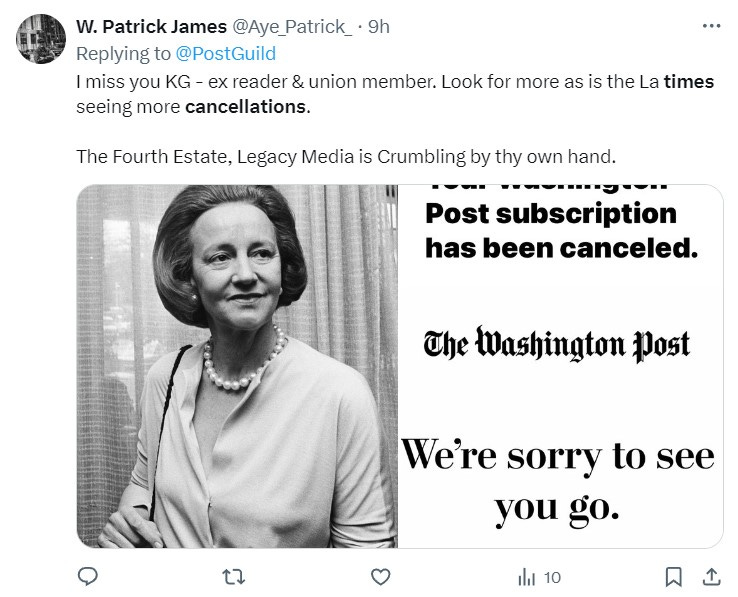
That career, however brief, was largely inspired by the Washington Post and its legendary coverage of the infamous Watergate Scandal.
During the late 1970s and early 80s, you couldn’t walk past any congressional or trade association office on any workday morning without seeing nearly every professional studiously perusing The Post. My wife chastised me as I was reading The Post at her bedside as she was about to give birth to our second son at Arlington Hospital on an early May morning in 1994. “Put that away!” I remember her ordering. We joke about it now. Well, I do, anyway.
“I always read the Style Section first. That’s where the news is.”
The late US Senator and then-President Pro Tempore Strom Thurmond (R-SC), telling me in 1995 which part of the Washington Post he read first in the morning. The Style Section is where the gossip columnists did their work.
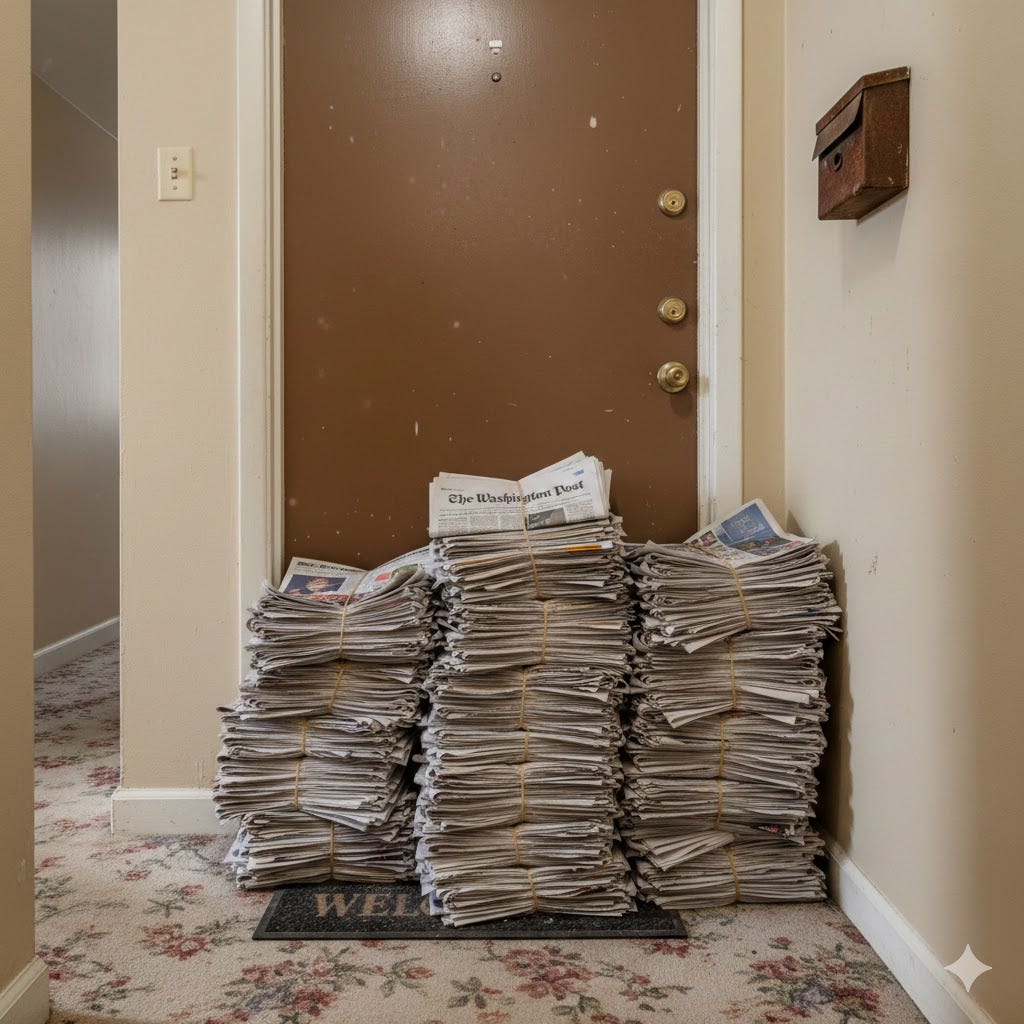
When my oldest son graduated from Bucknell University in 2007 and immediately moved into a condo we owned in Arlington for his first full-time job on Capitol Hill, one of the first things I did was arrange for a subscription to The Post. I would often visit his condo to find unopened and unread Washington Post newspapers piled up at his doorstep. It was about that time that newspaper subscriptions and reading were in free fall. His generation (Millenials) got its news by other means. They still do, as do their successors.
I’ve met and briefed the legendary Bob Woodward, who, along with Carl Bernstein and the late editor Ben Bradlee, sent journalism’s profile and popularity into orbit with their historic coverage of the Watergate Scandal. Never mind that Geoff Shephard and others have exposed a few, umm, issues with the reality of that scandal, and not only Nixon’s role in it, but also other government and media officials. This, from Amazon’s summary of Shepard’s must-read, The Nixon Conspiracy:
The Nixon Conspiracy is a detailed and definitive account of the Watergate prosecutors’ internal documents uncovered after years of painstaking research in previously sealed archives. Shepard reveals the untold story of how a flawed but honorable president was needlessly brought down by a corrupt, deep state, big media alliance — a circumstance that looks all too familiar today. In this hard-hitting exposé, Shepard reveals the real smoking gun: the prosecutors’ secret, but erroneous, “Road Map” which caused grand jurors to name Nixon a co-conspirator in the Watergate cover-up and the House Judiciary Committee to adopt its primary Article of Impeachment.
Shepard’s startling conclusion is that Nixon didn’t actually have to resign. The proof of his good faith is right there on the tapes. Instead, he should have taken his case to a Senate impeachment trial — where, if everything we know now had come out — he would easily have won.
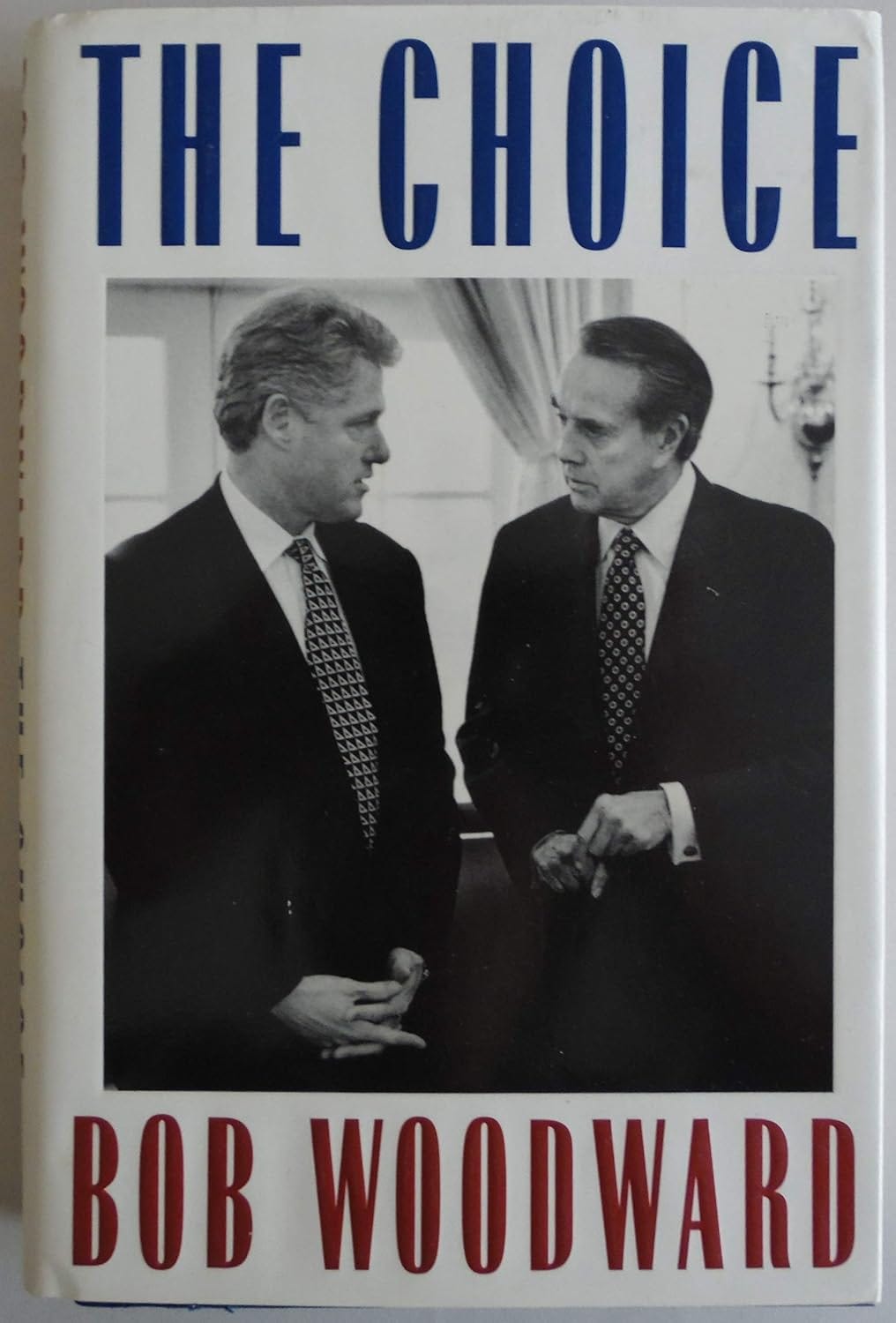
As I’ve previously noted, I’ve also been mentioned in one of Woodward’s books, “The Choice,” the definitive book of the 1996 presidential campaign between incumbent Bill Clinton and US Senator Bob Dole. I remember telling Woodward about that. “Was it accurate?” he asked. I assured him that he nailed it. It was about how I was chosen as the Secretary of the Senate as Dole’s presidential race began to take shape. Shepard was an attorney in the White House counsel’s office who was deeply involved in the aftermath of the scandal, which infamously started with a bungled break-in of the National Democratic Party’s headquarters at the Watergate apartment and hotel complex. It’s located along the banks of the Potomac River between the Kennedy Center to its south and the tony Georgetown neighborhood to the north and west. Perhaps you saw the movie, “All the President’s Men.”
Dole and his wife, Elizabeth, lived in the Watergate for most of their marriage and public service careers. And it seems most reporters and writers have stopped asking or worrying if their stories and reporting are “accurate.” Or even fair.
Neither the Washington Post nor the New York Times has ever admitted that their Pulitzer Prize for the phony Trump-Russia Collusion Hoax was based on falsehoods and deep-state-fed narratives (the Steele Dossier, for one), or its collusion with deep-state operatives like disgraced former CIA Director John Brennan. Donald Trump’s defamation suit against the newspapers proceeds through a glacially paced discovery process. He might win. A $30 million special investigation by former FBI Director Robert Mueller that included Democratic attack dog and partisan attorney Andrew Weissmann was forced to admit that there was no such evidence of “collusion.”
I could write a book or two or three about the Washington Post’s miscues over the years, and their coverage that harmed national security. I remember to this day opening up my Post to read Michael Weisskopf describing evangelical Christians as mostly “poor, uneducated, and easy to command.” I remember the Post compliantly following the lead of malevolent deep-state actors to parrot Biden campaign suggestions that Hunter Biden’s scurrilous laptop has “all the classic earmarks of a Russian disinformation campaign.” The last Republican they endorsed for President was Dwight Eisenhower nearly 70 years ago.
I especially remember the Washington Post’s Memorial Day weekend 1992 groundbreaking expose’ of the “secret bunker” at the Greenbrier Resort near White Sulphur Springs, West Virginia (now owned by former Gov. and US Senator Jim Justice). Amazingly, it was secretly constructed and operated since the Eisenhower Administration during most of the Cold War to ensure the continuity of government in case of a Soviet (or Chinese) nuclear attack. For a rather exorbitant fee ($52), you can get a guided tour of the bunker, some of which has now been converted into an underground casino.

When I visited the Greenbrier about 20 years ago, I remember asking my bunker tour guide where my bunk would have been, as the Secretary of the Senate. He then gave me an extra hour-long personal, private tour that included parts not open to the public, including where the CIA would have been sending and receiving messages.
It was a secret lying in plain sight for decades, and many locals knew of it and considered it a point of local pride. I always found it odd that I-64, for years, led from Chesapeake and Hampton Roads, Virginia, to White Sulphur Springs, then stopped (it has since been completed through the Mountaineer State and into Missouri). Or that Amtrak had a train that ran from DC’s Union Station to White Sulphur Springs, but no further (it is now the “Cardinal Line” that runs from DC to Chicago). And then there was the unusually long 7,000-foot runway at Greenbrier Valley Airport, almost exactly as long as the longest runway at Washington’s Reagan International Airport and suitable for military aircraft and Air Force One.

But as the Encyclopedia Britannica has outlined, “The Post suffered perhaps the greatest reporting embarrassment in its history when an article written by Janet Cooke recounting the life of an eight-year-old heroin addict proved to be false. The article, headlined ‘Jimmy’s World,’ won a Pulitzer Prize on April 13, 1981. Two days later The Post acknowledged that Jimmy had been made up by Cooke and returned the prize. The correction that is still appended to the article online says in part, “The following article is not factually correct and is a fabrication by the author.”
Amazon founder and chairman Jeff Bezos famously, if controversially, bought the Post in 2013 after Publisher Donald Graham, a position he inherited from his famous mother, Katherine Graham, threw in the towel after years of declining revenue and subscriptions. He claimed Bezos’s legendary expertise in technology would transform the once-legendary newspaper.
Oops. Maybe “technology” wasn’t the issue.
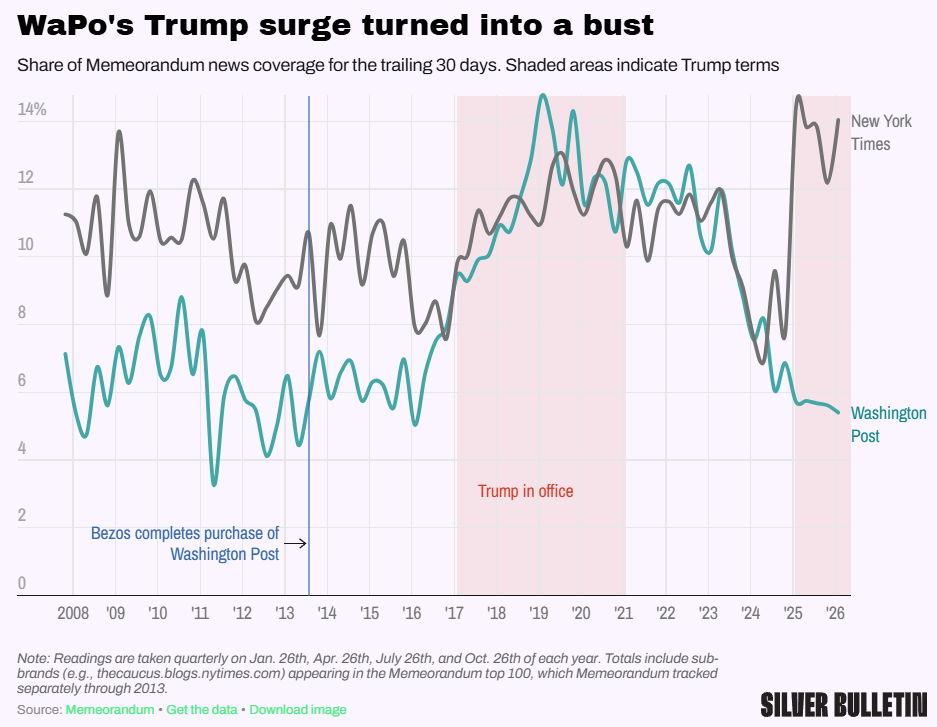
The Trump 45 era was very good for legacy media, including MSNBC (now MSNOW, whose owner, Comcast, has been unsuccessfully trying to sell it) and CNN. But it turns out to have been a hectic flush. The New York Times seems to be bucking the trend (for the record, I subscribe to both). I asked my Freespoke AI to explain why the Times is succeeding financially while the Post isn’t.
The New York Times has reported strong financial results, with significant growth in digital subscriptions, rising digital advertising revenue, and expanding profit margins in 2025. This success has been driven by the company's multi-revenue stream strategy, including its investment in diverse ancillary businesses such as cooking, games, and Wirecutter, and its ability to maintain a strong subscriber base. The New York Times also benefits from its extensive foreign affairs coverage, which is widely recognized as a vital resource.
So it appears the Times’ success may have less to do with its news coverage than with new businesses and interactive games like Wordle. Both newspapers will give you steep discounts if you push back and threaten to cancel. I continue to subscribe to the Post mostly for its vastly improved editorial pages, which feature a growing stable of several outstanding conservative writers, including Marc Thiessen and Jim Geraghty.
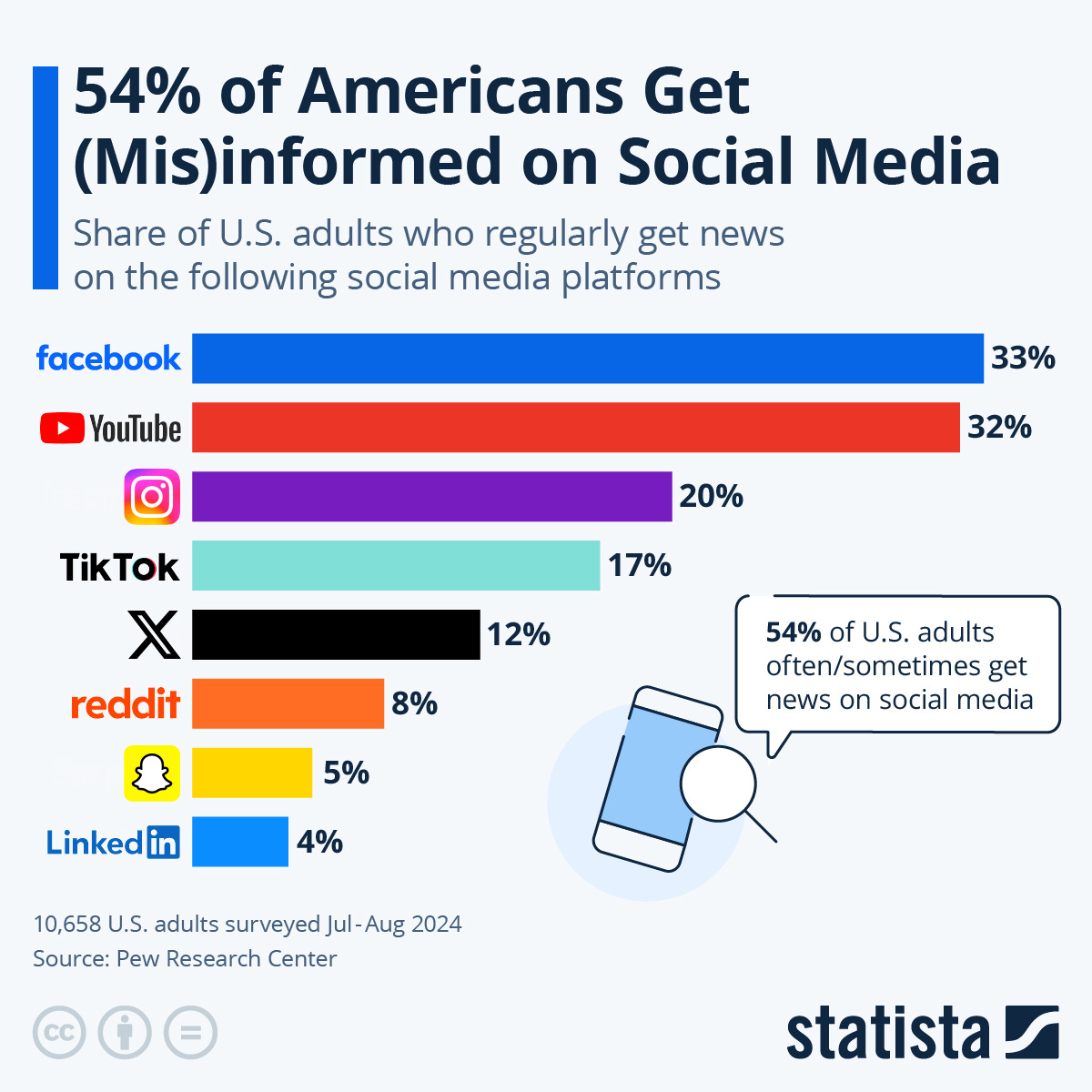
While I am somewhat concerned by the decline of traditional local media and the dubious quality and integrity of much digital “reporting” and opining, I’m shedding no tears for the Post or any other major daily newspaper, magazine, or broadcast outlet. I get the external forces that are making this a very tough time for my former profession and those still in it. Yet many traditional journalists continue to thrive by going out on their own through platforms like WordPress and Substack to share their work directly. Salena Zito is a great example. She once lamented losing her full-time job at the Pittsburgh Post-Gazette, only to thrive by creating her own website and being picked up by several other publications, including the Washington Post, the Washington Examiner, the New York Post, and others.
Salena has built quite a brand as a writer under the moniker “Middle of Somewhere,” focusing on Pennsylvania politics, her home environs in western Pennsylvania, and small-town culture in Appalachia and surrounding states. She seems to be setting herself up to be the leading reporter to cover the upcoming Josh Shapiro campaign for President (Pennsylvania’s Democratic governor, who is currently running for reelection in 2026).
Zito is also the author of one of the definitive books on the 2024 election, “Butler,” and of the 2016 “Great Revolt,” which she wrote with Brad Todd. She coined the famous phrase by how media and Trump supporters evaluate the President: “…the press takes him literally, but not seriously; his supporters take him seriously, but not literally.” Trump, for his part, considers Zito his favorite journalist. She’s also a favorite of Pennsylvania’s interesting Senior Senator, John Fetterman. Zito also teaches journalism at Hillsdale College’s Kirby School in Washington, DC.
Meanwhile, we’ve seen a flood of “citizen journalists” arise as it has become easier, taking little more than a smartphone or laptop and a free Substack or Facebook account, to create one’s own journalistic venue. Perhaps you’ve heard the name Nick Shirley, who exposed the multibillion-dollar child care and autism center scandal amongst the Somali community in Minneapolis. Or, perhaps, James O’Keefe, who masterfully goes undercover to surreptitiously interview Planned Parenthood execs talking about selling baby body parts, and more. Between on-demand podcasts and Substack pages, we are inundated with all kinds of journalism.
Discernment is skill that’s never been more important, and too few people have it.
It can be a little overwhelming to decide which ones to follow. Some former journalists have gone fully independent, including Rolling Stone’s Matt Taibbi.

My own nearby community of Purcellville, Virginia, a small town of about 10,000 people and is currently embroiled in controversies and a recall campaign involving its four-member council majority, which calls itself “Team Mayberry.” Several citizens have created local news sites and Facebook pages to report on council meetings and controversies. Three newspapers here in Loudoun County, Virginia, are still doing well, including the Times-Mirror, Loudoun Now, and the Blue Ridge Leader.
That’s not true everywhere or for everyone. Zito has written about the demise of The Derrick and News-Herald, an Oil City, Pennsylvania-based publishing company that’s going out of business. The nearby Pittsburgh Post-Gazette has announced that it is ceasing all operations as of May 8th. Looks like Zito, who was laid off by the Post-Gazette, may have the last laugh (although no one is laughing, especially her).
This is less the “fault” of any one publisher or publication, or the advent of social media alone, which no doubt contributes towards it. Several technological inventions have changed the manner and speed by which we communicate, both to each other and the pubic at large. Statistician Nate Silver has opined that while the Post’s demise is largely self-inflicted, it is also a symptom of Americans becoming less informed.
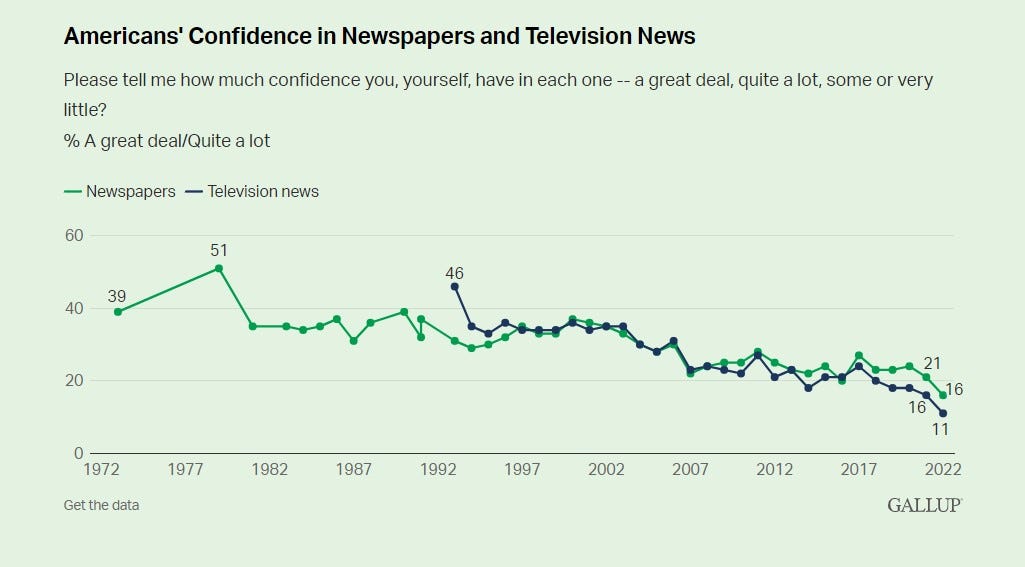
While I fully agree that the Post’s demise is largely self-inflicted, he’s not entirely correct that the Post is a victim of Americans becoming “less informed.” If anything, Americans have never been more bombarded with information. To the extent Americans are “uninformed,” it’s a choice they make, attributed somewhat to being turned off by the yelling of talking heads or the Outrage Machine™. The question is not just how to curate our news, but who we can trust to curate or aggregate information on our behalf. Defenders of legacy or traditional media claim that we need them to help us know what the news is and how to interpret it, but we’ve never trusted them less. Meanwhile, many of those same outlets and writers have fed us with false narratives and sins of both commission and omission, as malevolent government officials led them by the nose.
There’s no better example than the Covid-19 pandemic.
Canada’s parliament enacted C-18, the Online News Act, to force social media companies to pay for legacy-media-driven content. How has that worked out? Let’s ask Freespoke AI:
Canada’s law requiring social media companies to pay for news, officially known as Bill C-18 or the Online News Act, became law in June 2023. The legislation mandates that tech giants like Google and Meta (Facebook and Instagram) compensate Canadian news outlets for making their content available on their platforms. The intent of this law is to create a more equitable digital news marketplace and support the sustainability of Canadian journalism, which has experienced declining advertising revenues. The Canadian Radio-television and Telecommunications Commission (CRTC) oversees the administration of this regime, which defines eligible news businesses as those regularly employing two or more journalists in Canada, operating largely within Canada, and producing content edited and designed domestically.
In response to the Online News Act, Meta began blocking news content on its Facebook and Instagram platforms for all Canadian users before the law fully came into effect. This decision was a direct reaction to the legislation, with Meta stating that the law is based on an incorrect premise that social media companies unfairly benefit from news content, arguing that news outlets voluntarily share content to expand their audience. In contrast, Google reached an agreement with the Canadian federal government in November 2023 to comply with Bill C-18. Under this agreement, Google committed to making annual payments of approximately $100 million CAD to a collective fund for Canadian news outlets, indexed to inflation.
Just as buggy whip manufacturers became irrelevant more than a century ago, newspapers have struggled to adapt (there are exceptions). Many won’t make it, just as many colleges and universities are now struggling. In the meantime, the marketplace is speaking through new entities, such as news aggregators like Ground.news and publications like the Washington Free Beacon have stepped up.
These are turbulent, unsettling times in many ways, across the spectrum, and the pace of change is accelerating in mind-numbing ways. It’s almost impossible to keep up. It’s stressful, to say the least.
Anyone and any entity can create a newspaper or news outlet, and many have. Where this all winds up, and whether innovative journalists like Bari Weiss, the founder of the wildly successful The Free Press and now head of CBS News will make legacy media relevant again and turn things around remain to be seen. But we should welcome, even celebrate this and not try to save or protect increasingly obsolete publications with clueless writers who can’t seem to attract eyeballs or advertisers with their vitriol, projection, logical fallacies, and gaslighting. The waters will be choppy, and problems will arise, including fake AI photos and stories crafted by malevolent forces.
As for now, I’m not shedding any tears for the demise of the Washington Post.
Neither should you. Let the market work. The Post isn’t dead yet, and might find its way back. They can start with rediscovering the mission of true journalism: the relentless pursuit of facts and truth, presenting them in a fair and honest way, and letting consumers draw and act on their own conclusions and judgments. We reject indoctrination. If Americans demand and reward relevant, unbiased, and valuable facts and information, the market place will provide it, and those that don’t, will die. In fact, that’s what’s happening.
Thanks Kelly, very good article. I can’t add anything of value to the many good points, so I’ll just make a couple extraneous personal observations.
1) I assume your muscle bike had the same extra high “easy rider” handlebars that mine did.
2) I’ve always found it irritating that many of those who would have received refuge from armageddon at Greenbrier would probably have been the same ones who played a big part in causing armageddon. Note: I do NOT include the Secretary of the Senate in this comment 😉.
From one paperboy to another, a truly excellent piece.